CCM Requirements in 2026 Explained: What Providers Must Know
OnCare360
Dec 19, 2025
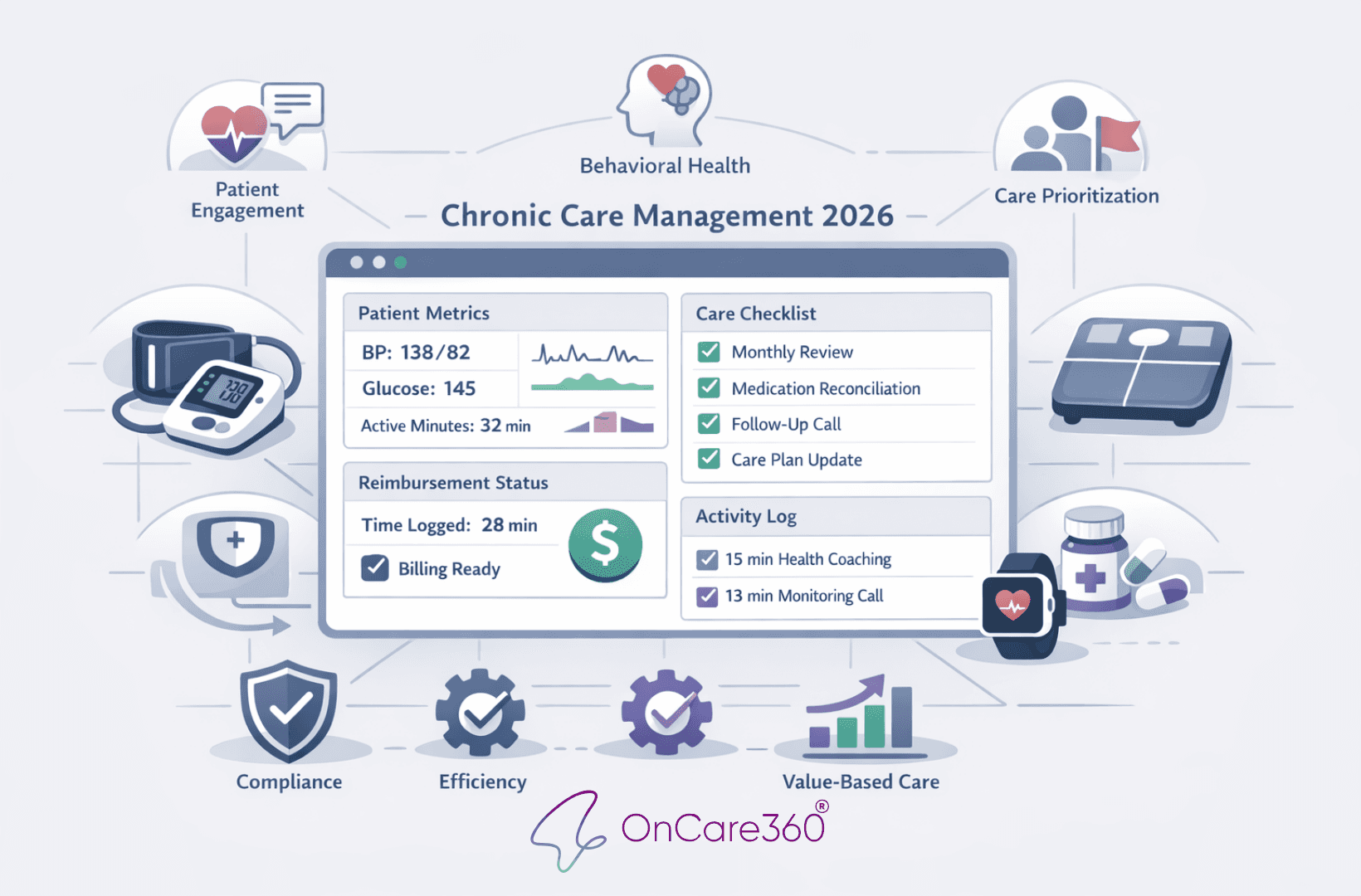
Chronic Care Management (CCM) is a Medicare service for patients with two or more chronic conditions requiring ongoing care coordination. Starting January 1, 2026, Medicare will implement updated billing codes, reimbursement rates, and compliance standards for CCM, including new behavioral health integration add-ons. These changes aim to improve care delivery and financial outcomes for practices while ensuring compliance with Medicare policies.
This guide outlines key 2026 updates: eligibility criteria, billing codes, documentation rules, and strategies to optimize revenue. Physician groups, practice administrators, and value-based care leaders will gain actionable insights to navigate these changes effectively and maintain audit readiness.
2026 CCM Eligibility and Billing Codes
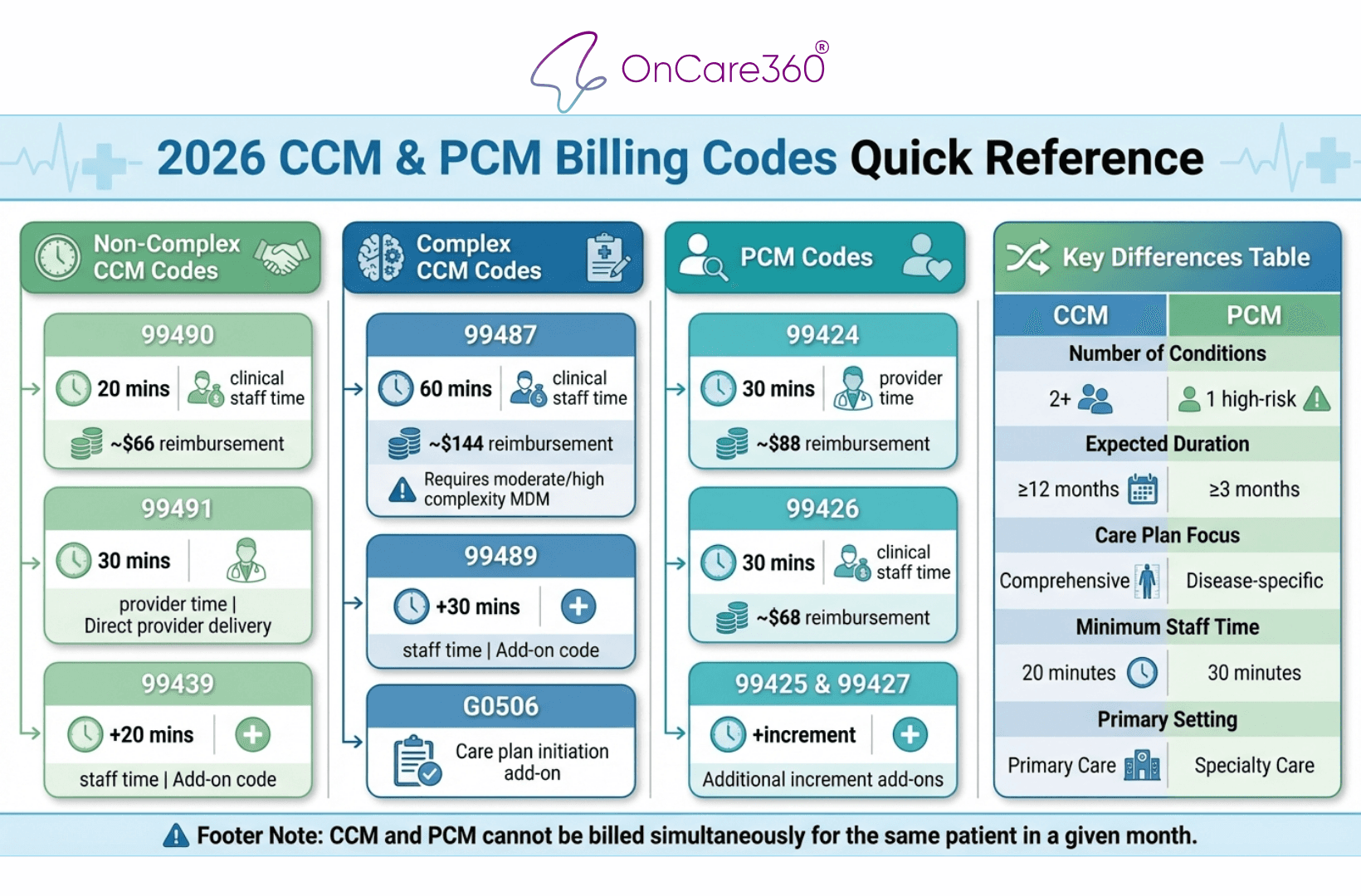
CCM vs PCM Billing Codes Comparison Chart 2026
Properly identifying eligible patients and using the correct billing codes is essential for building a compliant and effective Chronic Care Management (CCM) program. Medicare offers several billing options based on patient needs, time spent, and whether care is provided by clinical staff or directly by the provider.
Who Qualifies for CCM Services
To qualify for CCM, patients must have at least two chronic conditions expected to last 12 months or longer (or be lifelong) and carry a significant risk of worsening health. Common conditions include diabetes, hypertension, heart failure, chronic obstructive pulmonary disease (COPD), and chronic kidney disease.
Before billing, providers must document patient consent in the electronic health record (EHR). This consent should include details about cost-sharing (typically $8–$9 per month), the patient’s right to discontinue services, and the rule that only one provider can bill for CCM services per month. Additionally, a care plan must be created in a certified EHR system, with a copy given to the patient. Patients must also have 24/7 access to a member of the care team for urgent chronic care issues.
"CMS expects that physicians will particularly focus on eligible patients with higher acuity and higher risk (e.g., patients with four or more chronic conditions) when furnishing CCM services because the benefits are likely to be greater." - Kent Moore, Senior Strategist for Physician Payment, AAFP
A risk-stratified approach can help prioritize patients who will benefit most from CCM. For example, patients with four or more chronic conditions or frequent emergency room visits should be considered for enrollment. This framework simplifies the process of determining eligibility and selecting the appropriate billing codes.
Non-Complex and Complex CCM Codes
Medicare provides distinct codes for non-complex and complex CCM services, which differ based on time spent and the complexity of medical decision-making (MDM).
Non-complex CCM:
99490: 20 minutes of clinical staff time.
99491: 30 minutes of provider time delivered personally.
99439: Each additional 20 minutes of staff time.
These codes are used for routine care coordination tasks like medication reconciliation, scheduling follow-ups, and patient education.
Complex CCM:
99487: 60 minutes of clinical staff time, requiring moderate or high complexity MDM.
99489: Each additional 30 minutes of staff time.
Complex CCM codes are appropriate for patients needing more intensive care coordination, such as substantial revisions to their care plan. To bill 99487, providers must document that the patient’s situation required moderate or high complexity MDM, not just additional time. Additionally, G0506 can be billed as an add-on code during care plan initiation.
Financially, these codes reflect the level of care provided. For instance, in 2026, 99490 reimburses approximately $66, while 99487 reimburses around $144. Choosing the correct code ensures compliance and accurate reimbursement.
Principal Care Management (PCM) Codes
Principal Care Management (PCM) is designed for patients with a single high-risk chronic condition that requires focused monitoring or frequent adjustments. Unlike CCM, which addresses multiple conditions, PCM is ideal for specialists managing a dominant condition, such as cardiologists treating severe heart failure or oncologists coordinating cancer care.
The primary PCM codes include:
99424: 30 minutes of provider time.
99426: 30 minutes of clinical staff time.
Add-on codes: 99425 and 99427 for additional increments.
PCM and CCM cannot be billed simultaneously for the same patient in a given month. Providers must decide which code set aligns with the patient’s clinical needs. For example, a patient initially managed under PCM may transition to CCM if additional chronic conditions develop.
Feature | Chronic Care Management (CCM) | Principal Care Management (PCM) |
|---|---|---|
Number of Conditions | 2 or more | 1 high-risk condition |
Expected Duration | ≥12 months or until death | ≥3 months |
Care Plan Focus | Comprehensive (all conditions) | Disease-specific (single condition) |
Minimum Staff Time | 20 minutes | 30 minutes |
Primary Setting | Primary Care | Specialty Care |
PCM allows specialists to focus on a single high-risk condition while ensuring fair reimbursement. For 2026, the reimbursement rates for 99424 and 99426 are approximately $88 and $68, respectively. Understanding these distinctions helps providers align with 2026 guidelines and optimize revenue while maintaining compliance.
Documentation and Time Tracking Rules
After addressing billing codes and time requirements, let’s delve into the documentation needed to support your claims. Accurate record-keeping and diligent time tracking are crucial for maintaining CCM compliance. Providers must adhere to minimum time thresholds for each billing code, keep detailed logs of staff time, and store all records in a certified EHR system. Failure to meet these standards can lead to audits and potential claim denials.
Time Requirements for Each Code
Each CCM and PCM billing code has a specific minimum time threshold that must be met before submission. CMS guidelines are strict - time must meet or exceed these thresholds. For instance, if a clinical staff member spends 18 minutes on CCM tasks, the practice cannot bill 99490, which requires at least 20 minutes.
Code | Service Type | Minimum Time Requirement | Provider/Staff |
|---|---|---|---|
99490 | Non-complex CCM | 20 minutes per month | Clinical Staff |
99439 | Add-on Non-complex | Each additional 20 minutes | Clinical Staff |
99491 | Provider CCM | 30 minutes per month | Physician/QHP |
99487 | Complex CCM | 60 minutes per month | Clinical Staff |
99489 | Add-on Complex | Each additional 30 minutes | Clinical Staff |
99426 | PCM (Initial) | 30 minutes per month | Clinical Staff |
99424 | PCM (Initial) | 30 minutes per month | Physician/QHP |
Time spent on CCM cannot be double-counted toward other programs such as RPM, RTM, or PCM.
Time logs should include the date, staff member, and minutes spent on each activity. For example, if two staff members discuss a care plan for 10 minutes, only 10 minutes can be counted - this avoids double-counting and ensures compliance.
"The 20 minutes per calendar month is a minimum threshold (i.e., you may not round up your time spent in order to meet it), and you can count the time of only one clinical staff member for a particular segment of time."
– Kent Moore, Senior Strategist for Physician Payment, AAFP
With these thresholds in place, precise record-keeping is essential to support billing claims.
How to Maintain Compliant Records
Accurate time tracking is just the beginning. Proper documentation ensures compliance and reduces audit risks. Practices must keep detailed logs and records, including patient consent, which should be stored in the EHR.
A comprehensive care plan is another cornerstone of compliance. This plan must be created, implemented, updated, or monitored and stored in a certified EHR system. A copy should also be provided to the patient. The care plan should encompass all chronic conditions, medications, and coordination needs across specialties. Regular updates to the care plan are essential for billing complex CCM services.
Communication logs play a critical role during audits. These logs should document all non-face-to-face interactions, such as phone calls, secure messages, prescription refills, and collaboration with other providers. Practices must also ensure patients have 24/7 access to the care team for urgent chronic care needs. Additionally, care transition records - like follow-ups after emergency department visits or hospital discharges - should include the electronic exchange of summary care records.
"Documenting this time in the patient's record will be a necessity to reduce your audit risk."
– Kent Moore, Senior Strategist for Physician Payment, AAFP
Regular internal audits can help verify that time logs align with documented interventions in progress notes. These audits also ensure that CCM and PCM activities are clearly distinguished. Using standardized logs and progress notes minimizes audit risks and simplifies compliance. Practices should confirm that their EHR systems meet current CMS certification standards for structured data, including demographics, problems, and medications.
2026 Reimbursement Rates and Revenue Opportunities
Grasping the nuances of the 2026 reimbursement framework can help practices maximize revenue from Chronic Care Management (CCM) and Principal Care Management (PCM) programs. For 2026, the Centers for Medicare & Medicaid Services (CMS) introduced two Medicare conversion factors - one for participants in Alternative Payment Models (APMs) and another for non-APM participants. Both factors show a modest increase compared to 2025. Importantly, care management services are shielded from the -2.5% efficiency adjustment that impacts many non–time-based services. Below is a summary of the conversion factors and reimbursement details.
2026 CCM and PCM Reimbursement Table
Metric | 2025 Conversion Factor | 2026 Conversion Factor (Non-APM) | 2026 Conversion Factor (APM) |
|---|---|---|---|
Medicare Conversion Factor | $32.35 | $33.40 | $33.57 |
Note: Rates are approximate and subject to geographic adjustments and final RVU assignments.
CMS’s decision to protect CCM and PCM codes underscores a broader shift in priorities, favoring chronic disease management and care coordination over traditional procedural volume.
"CMS's message is crystal clear: shift from procedural volume to chronic disease management, preventive care, and care coordination."
– Ryder Wyatt, A2Z Billings
This shift is timely, as Medicare reimbursement to physicians has dropped by 33% between 2001 and 2025 when adjusted for inflation. Understanding these changes is key, but practices can go further by refining their operational strategies to unlock additional revenue opportunities.
How to Increase CCM Revenue
The 2026 reimbursement structure supports practices aiming to enhance both compliance and revenue growth. Practices that streamline workflows and actively engage patients have seen revenue increases of 8–15% within 90 days through charge capture audits.
One effective approach is leveraging Annual Wellness Visits (AWVs) to boost patient enrollment in CCM services. AWVs serve as the initiating visit for CCM and are billed separately. During these visits, clinical staff can secure patient consent, complete initial assessments, and bill HCPCS code G0506 for extensive care planning that goes beyond a standard evaluation and management visit.
For practices managing patients with more complex needs, using add-on codes can significantly enhance monthly revenue. While these codes come with specific time and documentation requirements, they are a valuable tool for addressing the needs of high-acuity patients. Additionally, enrolling in Alternative Payment Models offers financial benefits, with a $0.17 per RVU increase in the conversion factor for APM participants. This seemingly small adjustment can lead to substantial revenue gains across a large patient panel.
Another opportunity lies in adopting the new Advanced Primary Care Management (APCM) G-codes (G0568, G0569, G0570), which allow practices to bill for behavioral health services integrated with chronic disease management. By incorporating these codes, practices can address mental health needs while simultaneously increasing revenue.
"Medicare is betting on real human contact, not just procedures. That's where the ROI lives now."
– Connor Danielowski, Chronic Care Staffing
How OnCare360 Supports CCM Compliance and Growth
OnCare360 brings all aspects of between-visit care into a single, integrated operating system, combining automated compliance tools with AI-powered coordination to meet 2026 Chronic Care Management (CCM) requirements. The platform is tailored to align with the 2026 shift toward Advanced Primary Care Management (APCM), including the optional behavioral health add-on codes. Below, we explore how these features fit seamlessly into daily practice operations.
A Unified Platform for Between-Visit Care
OnCare360 eliminates the need for juggling multiple systems by unifying CCM, Remote Patient Monitoring (RPM), Transitional Care Management (TCM), and Principal Care Management (PCM) into one streamlined workflow. This integration reduces data silos and administrative burdens, making care coordination for patients with multiple chronic conditions more efficient. By simplifying these processes, practices can meet 2026 quality standards while improving overall care coordination. Additionally, the platform supports the permanent adoption of virtual direct supervision, enabling supervising practitioners to oversee incident-to services using real-time audio and video communication.
Streamlined Compliance and Documentation
Accurate documentation is critical for audit readiness, and OnCare360 simplifies this with automated time-tracking tools that log all non-face-to-face activities - such as phone calls, prescription management, and care coordination - precisely. Since care management services are exempt from the new -2.5% efficiency adjustment applied to other non-time-based codes, thorough time tracking remains a key factor in reimbursement. The platform also automates consent management and record-keeping, ensuring compliance with CMS documentation standards without adding extra work for staff. These features allow practices to maintain compliance while managing growing patient panels efficiently.
Efficient Management of Larger Patient Panels
OnCare360 leverages AI tools to help small teams manage larger patient panels without compromising care quality. With features like prioritization cues, risk alerts, and documentation prompts, the platform supports clinicians in making informed decisions while ensuring licensed professionals retain full control over care interventions. This approach enables practices to scale their CCM programs responsibly, maintaining high clinical standards and supporting revenue growth under the 2026 guidelines. The system also provides the necessary infrastructure to handle the increasing complexity of care, including updates to beneficiary assignment methodologies that integrate behavioral health services.
Getting Ready for 2026 CCM Requirements
Preparing for the 2026 Chronic Care Management (CCM) updates involves addressing three key changes: updated conversion factors, new behavioral health add-on codes, and finalized virtual supervision rules. Start by reviewing your conversion factors to ensure your billing systems align with the 2026 rates. Notably, care management services remain exempt from the -2.5% efficiency adjustment applied to other non-time-based codes, safeguarding a critical part of your revenue stream. These updates provide a framework for revising your care management protocols.
A crucial first step is to standardize consent and care plan workflows. For every CCM patient, documented consent must be recorded in your EHR at enrollment, along with a detailed care plan that includes measurable goals and assigned care team members. These two elements are frequent audit triggers, so implementing standardized templates and workflows now can help prevent denials later. Additionally, incorporate the APCM behavioral health add-on codes into your updated billing processes.
Automated time tracking is non-negotiable. Relying on manual logs often leads to gaps, while automated tools can accurately track start and stop times, staff roles, and patient activities. This ensures compliance with the 20-minute minimum required for codes like 99490. If you're billing for both CCM and Remote Patient Monitoring (RPM), maintain separate logs with clear, distinct rationales to avoid denials for duplicate services.
To streamline workflows further, consider technology platforms that unify CCM, RPM, Transitional Care Management (TCM), and Principal Care Management (PCM) into a single system. These tools reduce administrative complexity, enabling practices to scale their care management programs more efficiently. For example, OnCare360 integrates these updates seamlessly, offering AI-powered prioritization and audit-ready documentation tools, allowing clinical teams to focus more on patient care and less on administrative tasks. With the finalized virtual supervision rules, practices can also use remote oversight to manage larger patient panels without increasing staff.
As a final step, audit your current documentation practices to ensure they meet compliance standards, confirm your billing system reflects the new 2026 conversion factors, and identify patients eligible for the new behavioral health integration codes. Practices that take these steps early will be better positioned to navigate audits confidently and maximize reimbursement opportunities.
FAQs
What are the new behavioral health integration options for CCM in 2026?
At present, there isn't any specific information regarding new behavioral health integration add-ons for Chronic Care Management (CCM) in 2026. The Centers for Medicare & Medicaid Services (CMS) has not yet issued finalized guidelines or updates addressing potential changes in this area.
Healthcare providers should remain proactive by frequently checking CMS updates and announcements. Staying informed will help ensure compliance with future requirements and allow practices to take advantage of any new opportunities related to behavioral health integration within CCM programs.
What steps should providers take to comply with the 2026 CCM documentation requirements?
To align with the 2026 Chronic Care Management (CCM) documentation requirements, practices should prioritize three critical areas:
Patient Consent: Make sure to secure and document patient consent at the time of enrollment. This documentation should include the date, the staff member involved, and acknowledgment of any cost-sharing responsibilities. Missing or incomplete consent remains a frequent reason for claim denials.
Care Plan Documentation: Create a thorough care plan that outlines the patient’s problem list, prescribed medications, measurable health objectives, and a schedule for follow-up appointments. This plan should be updated monthly within the electronic health record (EHR) and clearly tied to medical decision-making and the services provided.
Time Tracking: Maintain precise records of the total non-face-to-face time spent on CCM activities like care coordination and patient education. Use a reliable time-tracking system to log start and stop times, staff roles, and specific activities. Ensure these logs meet the required time thresholds, such as 20 minutes for CPT 99490 or 60 minutes for CPT 99487.
Providing regular staff training on updated guidelines and conducting periodic audits of documentation can help identify and address any gaps. Integrating these practices into daily workflows not only ensures compliance but also safeguards reimbursement.
How can providers maximize revenue under the 2026 CCM guidelines?
To optimize revenue under the 2026 Chronic Care Management (CCM) guidelines, providers should prioritize three critical areas:
Detailed Documentation and Compliance
Verify patient eligibility by ensuring they have at least two chronic conditions and obtain documented consent, including the date and acknowledgment of any cost-sharing, within the electronic health record (EHR). Maintain a thorough, monthly care plan to avoid claim denials and secure the full per-member per-month (PMPM) reimbursement.Precise Time Tracking
Utilize automated tools to accurately record CCM activity, including start and stop times, staff roles, and services provided. Meeting the minimum 20-minute threshold for CPT 99490 is essential, as is documenting additional time for higher-complexity codes like 99487, 99489, and 99491. Conduct regular internal audits to catch and prevent duplicate billing from overlapping services.Adopting New Reimbursement Opportunities
Take advantage of updates in the 2026 Physician Fee Schedule, such as Advanced Primary Care Management (APCM) codes, which allow billing for high-risk patients and provide supplemental payments. Training staff on these updated documentation requirements and integrating the codes into EHR workflows can enhance revenue streams while ensuring the practice remains audit-ready.
CCM vs PCM Billing Codes Comparison Chart 2026
Properly identifying eligible patients and using the correct billing codes is essential for building a compliant and effective Chronic Care Management (CCM) program. Medicare offers several billing options based on patient needs, time spent, and whether care is provided by clinical staff or directly by the provider.
Who Qualifies for CCM Services
To qualify for CCM, patients must have at least two chronic conditions expected to last 12 months or longer (or be lifelong) and carry a significant risk of worsening health. Common conditions include diabetes, hypertension, heart failure, chronic obstructive pulmonary disease (COPD), and chronic kidney disease.
Before billing, providers must document patient consent in the electronic health record (EHR). This consent should include details about cost-sharing (typically $8–$9 per month), the patient’s right to discontinue services, and the rule that only one provider can bill for CCM services per month. Additionally, a care plan must be created in a certified EHR system, with a copy given to the patient. Patients must also have 24/7 access to a member of the care team for urgent chronic care issues.
"CMS expects that physicians will particularly focus on eligible patients with higher acuity and higher risk (e.g., patients with four or more chronic conditions) when furnishing CCM services because the benefits are likely to be greater." - Kent Moore, Senior Strategist for Physician Payment, AAFP
A risk-stratified approach can help prioritize patients who will benefit most from CCM. For example, patients with four or more chronic conditions or frequent emergency room visits should be considered for enrollment. This framework simplifies the process of determining eligibility and selecting the appropriate billing codes.
Non-Complex and Complex CCM Codes
Medicare provides distinct codes for non-complex and complex CCM services, which differ based on time spent and the complexity of medical decision-making (MDM).
Non-complex CCM:
99490: 20 minutes of clinical staff time.
99491: 30 minutes of provider time delivered personally.
99439: Each additional 20 minutes of staff time.
These codes are used for routine care coordination tasks like medication reconciliation, scheduling follow-ups, and patient education.
Complex CCM:
99487: 60 minutes of clinical staff time, requiring moderate or high complexity MDM.
99489: Each additional 30 minutes of staff time.
Complex CCM codes are appropriate for patients needing more intensive care coordination, such as substantial revisions to their care plan. To bill 99487, providers must document that the patient’s situation required moderate or high complexity MDM, not just additional time. Additionally, G0506 can be billed as an add-on code during care plan initiation.
Financially, these codes reflect the level of care provided. For instance, in 2026, 99490 reimburses approximately $66, while 99487 reimburses around $144. Choosing the correct code ensures compliance and accurate reimbursement.
Principal Care Management (PCM) Codes
Principal Care Management (PCM) is designed for patients with a single high-risk chronic condition that requires focused monitoring or frequent adjustments. Unlike CCM, which addresses multiple conditions, PCM is ideal for specialists managing a dominant condition, such as cardiologists treating severe heart failure or oncologists coordinating cancer care.
The primary PCM codes include:
99424: 30 minutes of provider time.
99426: 30 minutes of clinical staff time.
Add-on codes: 99425 and 99427 for additional increments.
PCM and CCM cannot be billed simultaneously for the same patient in a given month. Providers must decide which code set aligns with the patient’s clinical needs. For example, a patient initially managed under PCM may transition to CCM if additional chronic conditions develop.
Feature | Chronic Care Management (CCM) | Principal Care Management (PCM) |
|---|---|---|
Number of Conditions | 2 or more | 1 high-risk condition |
Expected Duration | ≥12 months or until death | ≥3 months |
Care Plan Focus | Comprehensive (all conditions) | Disease-specific (single condition) |
Minimum Staff Time | 20 minutes | 30 minutes |
Primary Setting | Primary Care | Specialty Care |
PCM allows specialists to focus on a single high-risk condition while ensuring fair reimbursement. For 2026, the reimbursement rates for 99424 and 99426 are approximately $88 and $68, respectively. Understanding these distinctions helps providers align with 2026 guidelines and optimize revenue while maintaining compliance.
Documentation and Time Tracking Rules
After addressing billing codes and time requirements, let’s delve into the documentation needed to support your claims. Accurate record-keeping and diligent time tracking are crucial for maintaining CCM compliance. Providers must adhere to minimum time thresholds for each billing code, keep detailed logs of staff time, and store all records in a certified EHR system. Failure to meet these standards can lead to audits and potential claim denials.
Time Requirements for Each Code
Each CCM and PCM billing code has a specific minimum time threshold that must be met before submission. CMS guidelines are strict - time must meet or exceed these thresholds. For instance, if a clinical staff member spends 18 minutes on CCM tasks, the practice cannot bill 99490, which requires at least 20 minutes.
Code | Service Type | Minimum Time Requirement | Provider/Staff |
|---|---|---|---|
99490 | Non-complex CCM | 20 minutes per month | Clinical Staff |
99439 | Add-on Non-complex | Each additional 20 minutes | Clinical Staff |
99491 | Provider CCM | 30 minutes per month | Physician/QHP |
99487 | Complex CCM | 60 minutes per month | Clinical Staff |
99489 | Add-on Complex | Each additional 30 minutes | Clinical Staff |
99426 | PCM (Initial) | 30 minutes per month | Clinical Staff |
99424 | PCM (Initial) | 30 minutes per month | Physician/QHP |
Time spent on CCM cannot be double-counted toward other programs such as RPM, RTM, or PCM.
Time logs should include the date, staff member, and minutes spent on each activity. For example, if two staff members discuss a care plan for 10 minutes, only 10 minutes can be counted - this avoids double-counting and ensures compliance.
"The 20 minutes per calendar month is a minimum threshold (i.e., you may not round up your time spent in order to meet it), and you can count the time of only one clinical staff member for a particular segment of time."
– Kent Moore, Senior Strategist for Physician Payment, AAFP
With these thresholds in place, precise record-keeping is essential to support billing claims.
How to Maintain Compliant Records
Accurate time tracking is just the beginning. Proper documentation ensures compliance and reduces audit risks. Practices must keep detailed logs and records, including patient consent, which should be stored in the EHR.
A comprehensive care plan is another cornerstone of compliance. This plan must be created, implemented, updated, or monitored and stored in a certified EHR system. A copy should also be provided to the patient. The care plan should encompass all chronic conditions, medications, and coordination needs across specialties. Regular updates to the care plan are essential for billing complex CCM services.
Communication logs play a critical role during audits. These logs should document all non-face-to-face interactions, such as phone calls, secure messages, prescription refills, and collaboration with other providers. Practices must also ensure patients have 24/7 access to the care team for urgent chronic care needs. Additionally, care transition records - like follow-ups after emergency department visits or hospital discharges - should include the electronic exchange of summary care records.
"Documenting this time in the patient's record will be a necessity to reduce your audit risk."
– Kent Moore, Senior Strategist for Physician Payment, AAFP
Regular internal audits can help verify that time logs align with documented interventions in progress notes. These audits also ensure that CCM and PCM activities are clearly distinguished. Using standardized logs and progress notes minimizes audit risks and simplifies compliance. Practices should confirm that their EHR systems meet current CMS certification standards for structured data, including demographics, problems, and medications.
2026 Reimbursement Rates and Revenue Opportunities
Grasping the nuances of the 2026 reimbursement framework can help practices maximize revenue from Chronic Care Management (CCM) and Principal Care Management (PCM) programs. For 2026, the Centers for Medicare & Medicaid Services (CMS) introduced two Medicare conversion factors - one for participants in Alternative Payment Models (APMs) and another for non-APM participants. Both factors show a modest increase compared to 2025. Importantly, care management services are shielded from the -2.5% efficiency adjustment that impacts many non–time-based services. Below is a summary of the conversion factors and reimbursement details.
2026 CCM and PCM Reimbursement Table
Metric | 2025 Conversion Factor | 2026 Conversion Factor (Non-APM) | 2026 Conversion Factor (APM) |
|---|---|---|---|
Medicare Conversion Factor | $32.35 | $33.40 | $33.57 |
Note: Rates are approximate and subject to geographic adjustments and final RVU assignments.
CMS’s decision to protect CCM and PCM codes underscores a broader shift in priorities, favoring chronic disease management and care coordination over traditional procedural volume.
"CMS's message is crystal clear: shift from procedural volume to chronic disease management, preventive care, and care coordination."
– Ryder Wyatt, A2Z Billings
This shift is timely, as Medicare reimbursement to physicians has dropped by 33% between 2001 and 2025 when adjusted for inflation. Understanding these changes is key, but practices can go further by refining their operational strategies to unlock additional revenue opportunities.
How to Increase CCM Revenue
The 2026 reimbursement structure supports practices aiming to enhance both compliance and revenue growth. Practices that streamline workflows and actively engage patients have seen revenue increases of 8–15% within 90 days through charge capture audits.
One effective approach is leveraging Annual Wellness Visits (AWVs) to boost patient enrollment in CCM services. AWVs serve as the initiating visit for CCM and are billed separately. During these visits, clinical staff can secure patient consent, complete initial assessments, and bill HCPCS code G0506 for extensive care planning that goes beyond a standard evaluation and management visit.
For practices managing patients with more complex needs, using add-on codes can significantly enhance monthly revenue. While these codes come with specific time and documentation requirements, they are a valuable tool for addressing the needs of high-acuity patients. Additionally, enrolling in Alternative Payment Models offers financial benefits, with a $0.17 per RVU increase in the conversion factor for APM participants. This seemingly small adjustment can lead to substantial revenue gains across a large patient panel.
Another opportunity lies in adopting the new Advanced Primary Care Management (APCM) G-codes (G0568, G0569, G0570), which allow practices to bill for behavioral health services integrated with chronic disease management. By incorporating these codes, practices can address mental health needs while simultaneously increasing revenue.
"Medicare is betting on real human contact, not just procedures. That's where the ROI lives now."
– Connor Danielowski, Chronic Care Staffing
How OnCare360 Supports CCM Compliance and Growth
OnCare360 brings all aspects of between-visit care into a single, integrated operating system, combining automated compliance tools with AI-powered coordination to meet 2026 Chronic Care Management (CCM) requirements. The platform is tailored to align with the 2026 shift toward Advanced Primary Care Management (APCM), including the optional behavioral health add-on codes. Below, we explore how these features fit seamlessly into daily practice operations.
A Unified Platform for Between-Visit Care
OnCare360 eliminates the need for juggling multiple systems by unifying CCM, Remote Patient Monitoring (RPM), Transitional Care Management (TCM), and Principal Care Management (PCM) into one streamlined workflow. This integration reduces data silos and administrative burdens, making care coordination for patients with multiple chronic conditions more efficient. By simplifying these processes, practices can meet 2026 quality standards while improving overall care coordination. Additionally, the platform supports the permanent adoption of virtual direct supervision, enabling supervising practitioners to oversee incident-to services using real-time audio and video communication.
Streamlined Compliance and Documentation
Accurate documentation is critical for audit readiness, and OnCare360 simplifies this with automated time-tracking tools that log all non-face-to-face activities - such as phone calls, prescription management, and care coordination - precisely. Since care management services are exempt from the new -2.5% efficiency adjustment applied to other non-time-based codes, thorough time tracking remains a key factor in reimbursement. The platform also automates consent management and record-keeping, ensuring compliance with CMS documentation standards without adding extra work for staff. These features allow practices to maintain compliance while managing growing patient panels efficiently.
Efficient Management of Larger Patient Panels
OnCare360 leverages AI tools to help small teams manage larger patient panels without compromising care quality. With features like prioritization cues, risk alerts, and documentation prompts, the platform supports clinicians in making informed decisions while ensuring licensed professionals retain full control over care interventions. This approach enables practices to scale their CCM programs responsibly, maintaining high clinical standards and supporting revenue growth under the 2026 guidelines. The system also provides the necessary infrastructure to handle the increasing complexity of care, including updates to beneficiary assignment methodologies that integrate behavioral health services.
Getting Ready for 2026 CCM Requirements
Preparing for the 2026 Chronic Care Management (CCM) updates involves addressing three key changes: updated conversion factors, new behavioral health add-on codes, and finalized virtual supervision rules. Start by reviewing your conversion factors to ensure your billing systems align with the 2026 rates. Notably, care management services remain exempt from the -2.5% efficiency adjustment applied to other non-time-based codes, safeguarding a critical part of your revenue stream. These updates provide a framework for revising your care management protocols.
A crucial first step is to standardize consent and care plan workflows. For every CCM patient, documented consent must be recorded in your EHR at enrollment, along with a detailed care plan that includes measurable goals and assigned care team members. These two elements are frequent audit triggers, so implementing standardized templates and workflows now can help prevent denials later. Additionally, incorporate the APCM behavioral health add-on codes into your updated billing processes.
Automated time tracking is non-negotiable. Relying on manual logs often leads to gaps, while automated tools can accurately track start and stop times, staff roles, and patient activities. This ensures compliance with the 20-minute minimum required for codes like 99490. If you're billing for both CCM and Remote Patient Monitoring (RPM), maintain separate logs with clear, distinct rationales to avoid denials for duplicate services.
To streamline workflows further, consider technology platforms that unify CCM, RPM, Transitional Care Management (TCM), and Principal Care Management (PCM) into a single system. These tools reduce administrative complexity, enabling practices to scale their care management programs more efficiently. For example, OnCare360 integrates these updates seamlessly, offering AI-powered prioritization and audit-ready documentation tools, allowing clinical teams to focus more on patient care and less on administrative tasks. With the finalized virtual supervision rules, practices can also use remote oversight to manage larger patient panels without increasing staff.
As a final step, audit your current documentation practices to ensure they meet compliance standards, confirm your billing system reflects the new 2026 conversion factors, and identify patients eligible for the new behavioral health integration codes. Practices that take these steps early will be better positioned to navigate audits confidently and maximize reimbursement opportunities.
FAQs
What are the new behavioral health integration options for CCM in 2026?
At present, there isn't any specific information regarding new behavioral health integration add-ons for Chronic Care Management (CCM) in 2026. The Centers for Medicare & Medicaid Services (CMS) has not yet issued finalized guidelines or updates addressing potential changes in this area.
Healthcare providers should remain proactive by frequently checking CMS updates and announcements. Staying informed will help ensure compliance with future requirements and allow practices to take advantage of any new opportunities related to behavioral health integration within CCM programs.
What steps should providers take to comply with the 2026 CCM documentation requirements?
To align with the 2026 Chronic Care Management (CCM) documentation requirements, practices should prioritize three critical areas:
Patient Consent: Make sure to secure and document patient consent at the time of enrollment. This documentation should include the date, the staff member involved, and acknowledgment of any cost-sharing responsibilities. Missing or incomplete consent remains a frequent reason for claim denials.
Care Plan Documentation: Create a thorough care plan that outlines the patient’s problem list, prescribed medications, measurable health objectives, and a schedule for follow-up appointments. This plan should be updated monthly within the electronic health record (EHR) and clearly tied to medical decision-making and the services provided.
Time Tracking: Maintain precise records of the total non-face-to-face time spent on CCM activities like care coordination and patient education. Use a reliable time-tracking system to log start and stop times, staff roles, and specific activities. Ensure these logs meet the required time thresholds, such as 20 minutes for CPT 99490 or 60 minutes for CPT 99487.
Providing regular staff training on updated guidelines and conducting periodic audits of documentation can help identify and address any gaps. Integrating these practices into daily workflows not only ensures compliance but also safeguards reimbursement.
How can providers maximize revenue under the 2026 CCM guidelines?
To optimize revenue under the 2026 Chronic Care Management (CCM) guidelines, providers should prioritize three critical areas:
Detailed Documentation and Compliance
Verify patient eligibility by ensuring they have at least two chronic conditions and obtain documented consent, including the date and acknowledgment of any cost-sharing, within the electronic health record (EHR). Maintain a thorough, monthly care plan to avoid claim denials and secure the full per-member per-month (PMPM) reimbursement.Precise Time Tracking
Utilize automated tools to accurately record CCM activity, including start and stop times, staff roles, and services provided. Meeting the minimum 20-minute threshold for CPT 99490 is essential, as is documenting additional time for higher-complexity codes like 99487, 99489, and 99491. Conduct regular internal audits to catch and prevent duplicate billing from overlapping services.Adopting New Reimbursement Opportunities
Take advantage of updates in the 2026 Physician Fee Schedule, such as Advanced Primary Care Management (APCM) codes, which allow billing for high-risk patients and provide supplemental payments. Training staff on these updated documentation requirements and integrating the codes into EHR workflows can enhance revenue streams while ensuring the practice remains audit-ready.
Testimonials
Jan 5, 2026
CMS Updates: How RPM is changing in 2026
Jan 3, 2026
How AI Expands Care Coordinator Capacity
Jan 1, 2026
RPM Time Tracking Errors That Lead to Denials
Dec 31, 2025
CMS Consent Documentation: What Must Be Captured
Jan 5, 2026
CMS Updates: How RPM is changing in 2026
Jan 3, 2026
How AI Expands Care Coordinator Capacity
Jan 1, 2026
RPM Time Tracking Errors That Lead to Denials
Dec 31, 2025
CMS Consent Documentation: What Must Be Captured
Dec 30, 2025
Top 10 Documentation Errors in CCM & RPM
Dec 29, 2025
Audit-Ready Documentation: What CMS Expects
Jan 5, 2026
CMS Updates: How RPM is changing in 2026
Jan 3, 2026
How AI Expands Care Coordinator Capacity
Jan 1, 2026
RPM Time Tracking Errors That Lead to Denials
Dec 31, 2025
CMS Consent Documentation: What Must Be Captured
Dec 30, 2025
Top 10 Documentation Errors in CCM & RPM
Dec 29, 2025
Audit-Ready Documentation: What CMS Expects


Have questions?
Are you ready to explore the future of healthcare with OnCare360?
Contact us for more information or request a free consultation today.
Have questions?
Are you ready to explore the future of healthcare with OnCare360?
Contact us for more information or request a free consultation today.
Have questions?
Are you ready to explore the future of healthcare with OnCare360?
Contact us for more information or request a free consultation today.
Have questions?
Are you ready to explore the future of healthcare with OnCare360?
Contact us for more information or request a free consultation today.
Have questions?
Are you ready to explore the future of healthcare with OnCare360?
Contact us for more information or request a free consultation today.
Have questions?